
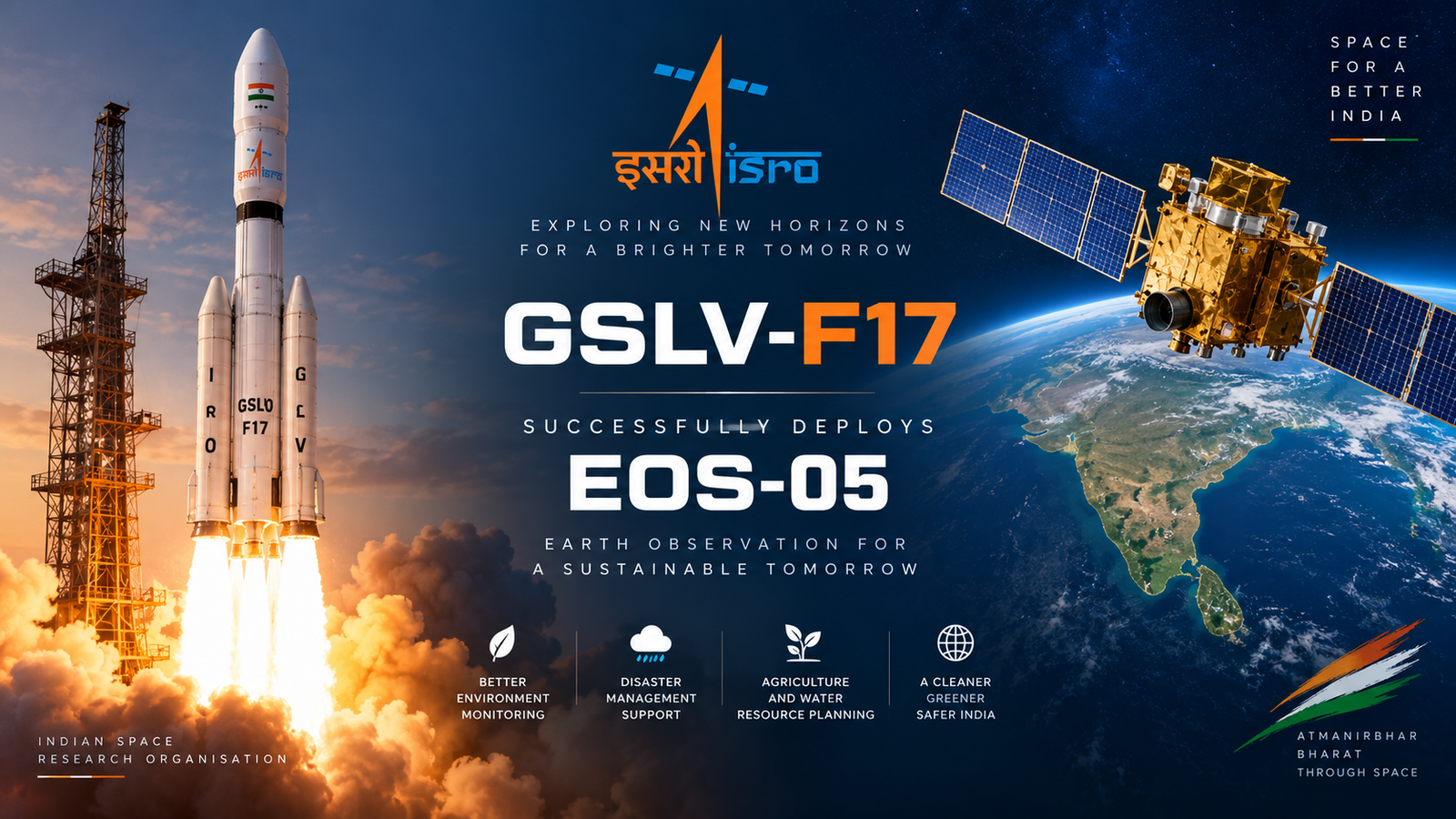
ISRO Successfully Launches GSLV-F17 Rocket Carrying EOS-05 Satellite

an Earth-observation satellite designed to operate from geosynchronous
orbit.
The Indian Space Research Organisation successfully launched the
GSLV-F17 rocket carrying the EOS-05 Earth-observation satellite from
Sriharikota on September 4, 2026.
According to ISRO, the mission successfully placed EOS-05 into its
intended Sub-Geosynchronous Transfer Orbit (Sub-GTO).
Successful Launch from Sriharikota
The GSLV-F17 lifted off from the Second Launch Pad at the Satish Dhawan
Space Centre in Sriharikota during the early hours of Friday.
The mission represents the 19th flight of India’s Geosynchronous
Satellite Launch Vehicle.
What Is EOS-05?
EOS-05 is an advanced Earth-observation spacecraft. ISRO describes it
as India’s first imaging satellite designed to operate from
geosynchronous orbit.
Operating from this type of orbit can provide extended observation of
a particular region, offering important capabilities for Earth
observation and monitoring.
Why the Mission Matters
Earth-observation satellites can provide valuable information for
applications such as agriculture, water-resource management,
environmental monitoring, urban planning and disaster management.
The EOS-05 mission therefore represents an important development in
India’s satellite-based Earth-observation capabilities.
What Happens After Launch?
Following deployment into its transfer orbit, EOS-05 will carry out
the necessary orbital manoeuvres before reaching its operational
geosynchronous orbit.
The satellite’s future observations are expected to contribute to
India’s growing use of space-based information for a range of
applications.
ISRO, September 4, 2026.
Additional reporting: Indian news media.